

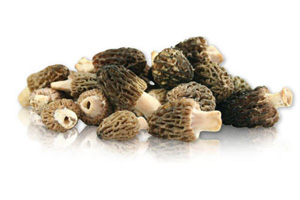
WHAT IS (& ISN’T) A WILD MUSHROOM
We all have our pet peeves about restaurant menus. One of ours is when they misrepresent cultivated mushrooms as wild mushrooms. The so-called “wild mushrooms” on your pizza were probably harvested from a block of inoculated wood chips in a dank warehouse.
Does the wild vs. cultivated distinction matter? We think so. Otherwise, restaurant menus and food marketers wouldn’t bother misrepresenting cultivated species as wild. Wild mushrooms don’t need the help of fertilizers or funky pesticides. Free of human intervention, they grow naturally to be extremely nutritious, protein dense, and exceptionally flavorful.
So, let’s set the record straight by talking about what is and isn’t a wild mushroom.
A mushroom is the fruiting body of an organism that lives in the soil. Some speculate they comprise an interconnected mushroom community that spans the globe. Truly wild mushrooms don’t grow in a controlled environment, they are foraged in the woods, in exactly the place where conditions are ideal for them to grow. They thrive along the mountain slopes and coastal areas in North America and grow all over the country, though most wild mushrooms sold in the United States are hand foraged in the Pacific Northwest.
What isn’t a wild mushroom? Shitake, oyster, portabella, and cremini are all cultivated mushrooms. They are delicious and may sound exotic, but they are just as wild as a carrot. The only connection they have to the wild is that they originate from a formerly wild species.
Here’s a list of mushrooms that are truly wild:
Chanterelle Mushrooms
Porcini Mushrooms
Lobster Mushrooms
Morel Mushrooms
Matsutake Mushrooms
Black Trumpet Mushrooms
Hedgehog Mushrooms
Yellowfoot Mushrooms
All our wild mushrooms are foraged in Washington and Oregon. We guarantee you that if an item on our website is labelled “wild,” it really and truly has been collected in the wild.
Browse more:
Comments 2
Pingback: Champagne Risotto with Wild Mushrooms | Inn The Kitchen
Pingback: Champagne Risotto with Wild Mushrooms -- The Travel Bite