

What is a quenelle?
Originally oddly shaped poached dumplings made from spiced meat or fish, the term quenelle has now come to refer more to the shape itself (a sort of curved oval football) regardless of what the substance being shaped is. These days you are most likely to see quenelles made from ice cream or whipped cream served with desserts. They’re just a way of introducing interesting new shapes to your plate.
How to make a quenelle:
The method for making quenelles is really quite simple, but requires practice to get a perfect result. Simply take a bowl of your intended garnish (in this case compound sage butter) and scoop out a spoonful with a large, somewhat deep metal spoon.
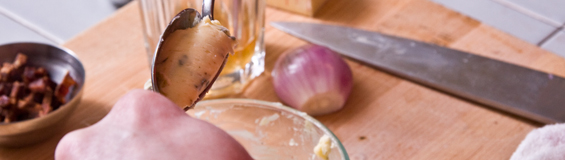
Then, take an identical spoon and scoop the garnish out from the first one, trying to follow the contour of the bottom spoon as much as possible. Continue to alternate from spoon to spoon until you have a smooth result. Depending on what you’re making into a quenelle, it may help to dip each spoon in warm water in between each scoop.
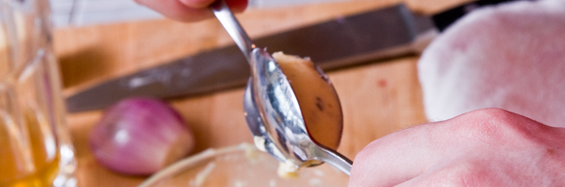
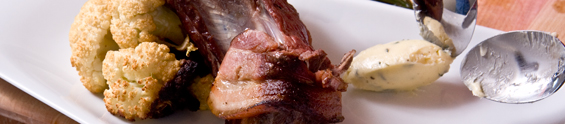
Quenelles should ideally be made right before serving your dish, but if you’re careful you may be able to get them to hold their shape for a short time either in the fridge or the freezer (if using ice cream).
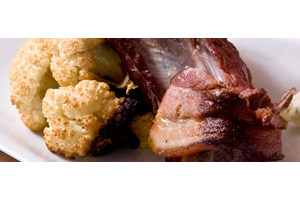
This sage butter quenelle was intended to accompany a roasted frenched kangaroo rack, but could be paired with a variety of different meats.
Comments 4
This is extremely interesting. The idea of a sage butter is very, very appealing. I would like to serve butter on a plate with bread shaped like this. Of course, I never thought of doing this before, but that’s what makes your site so fun. I’m also wondering if frenched kangaroo rack is really kangaroo meat. One of my friends lives in Australia. I will have to tell him about this.
Thanks for de-mystifying the technique.
Dear Lynn,
Sage butter is indeed awesome stuff. A blog post describing how to make this and other compound butters (one of my favorite culinary tricks) will be posted to the Marx Foods blog today.
And yes, the “frenched” (meaning some of the pre-cooking butchery is already done for you) kangaroo racks are 100% kangaroo, 100% Australian, and 100% tasty. We’re putting up a recipe centered around a kangaroo rack tomorrow, so stay tuned!
-Matthew
Pingback: Spuma di Mortadella Recipe - Everything Mom and Baby