

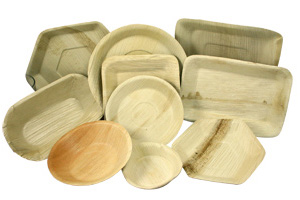
HOW PALM LEAF PLATES ARE MADE
The construction of environmentally friendly Palm Leaf Plates is a natural, renewable, and simple process:
DIRECTIONS
1
Freshly fallen, naturally discarded sheaths of the leaves of the Adaka palm tree are collected. To be clear, these are not pulled off the tree, nor are any trees cut down, as this is a non-timber forest resource. The trees naturally shed their old leaves, which are then picked up and put to good use.
2
Each raw sheath is then rinsed with water to remove any clinging dirt. It is then hand washed in a natural mixture of water and turmeric. The leaves are then rinsed a third time in water.
3
Once clean, the palm sheaths naturally air dry.
4
The palm leaves are then hand stretched and flattened. Various plate profiles, including round, square and hexagon-shaped dinner plates, are molded using a heated press. Multiple plates (of differing shapes and sizes) are often cut from each leaf to reduce waste.
5
Once clean and cut, each plate is sun-dried and packaged for sale.
In addition to this environmentally conscious production method, these durable palm leaf plates are also completely biodegradable and compostable (after all, they are literally a leaf), making them quite possibly the greenest disposable plates available.
So next time you’re throwing a big event—whether it’s burgers and ribs in the backyard, or a formal affair with filet mignons–leave the flimsy paper or forever-in-a-landfill plastic dishes alone and go palm plate instead!
Browse More:
Palm Plate Information
Comments 25
Would you post the palm leaf plates to Cape Town where i live?
Sorry durty, but right now we are only able to ship our palm leaf plates to locations within the U.S. and Canada.
Matthew
Are they one-time-use only, or can they be washed and reused?
Hi Lorna,
The palm leaf plates aren’t really designed to be reused, as they will deteriorate over time. However, they are tough enough that we have had several customers tell us they’ve washed them and reused them a couple times with no problems.
I would definitely recommend a relatively quick but thorough scrub rather than soaking, as leaving them in water for a long time will eventually soften them.
Thank you for your question!
Matthew
MarxFoods.com
How awesome~! I have a blog where I review products any and all if you would ever like someone to test the product and do a review I am your girl 🙂 I just can’t get over how these awesome products are 100% Natureal love it~!
Pingback: Marx Foods Palm Leaf Plates Review | Laughing Lindsay
Pingback: Foodie Blogroll, Palm Leaf Plates and Bread Pakora « Oh Taste n See
Pingback: Beer Can Chicken « Food By DB
Mani says
Areca leaf are called plam leaf. Is it true? Please let me know whether it is reusable. where we can get in U.S.
Mani says
Areca leaf are called plam leaf. Is it true? Please let me know whether it is reusable. where we can get in U.S.and Canada.
Hi Mani,
Yes, these plants are made from areca palm leaves (aka adaka/adakka palm). We’ve actually posted information about using them a second time on our other blog, check out Reusability of Palm Leaf Plates.
Ground shipping anywhere in the continental US is included in the price of the plates. We can also ship them faster or to Alaska, Hawaii, and Canada for an additional fee based on increased shipping/import costs.
Let us know if you have any other questions!
Matthew
MarxFoods.com
Pingback: VEGA Vegan Protein Patties and Marx Foods GIVEAWAY « The Healthy Apple
Pingback: Free lunch! « Emily Eats Clean
Pingback: Two Southern Girls » Palm Leaf Plates Review
Pingback: CookThatBook » Dog Days of Summer
Pingback: For the Love of the Plate | Kendra Too
Pingback: Palm Plates- A Review for Marx Food | apuginthekitchen
Pingback: Foodie Blogroll, Palm Leaf Plates and Bread Pakora » Oh Taste n See..... | Oh Taste n See.....
Pingback: For the Love of the Plate - incidentally me
Could you pls let me know the standard of quality with certification. I wanted a big order.
Hi Ayamany,
Our palm leaf plates are certified by the USDA as a Bio Based Product. They also pass through PhytoSanitation testing and spot checking at port arrival.
I hope that helps! Let us know if you have further questions.
Matthew
Marx Foods
Dear madam, sir,
My name is Patrick Beintema, I’m living in Indonesia.
I was wondering if you, by any chance, know if there are companies in Indonesia who make plates and cutlery from palm leafs. These products are so amazing!
I have read on internet that many of these products come from India. But are there companies in Indonesia who make them?
I am looking forward to your kind reply.
With kind regards,
Patrick Beintema
Hi Patrick,
Our plates are all made in India, and I’m afraid we’re not aware of any Indonesian producers or sellers. Maybe some Indian producers would be willing to ship to Indonesia?
Best of luck in your search.
Matthew
Marx Foods
Hi, good work you are doing. Considering you can’t ship out to Africa, can you send me detailed methodology so i can replicate same in Nigeria? If you don’t mind we can have it as partnership .
Hi Ogbole,
We don’t make the plates ourselves, so I’m afraid I don’t know the precise details to give you. Best of luck in your business plans!
Matthew
Marx Foods